
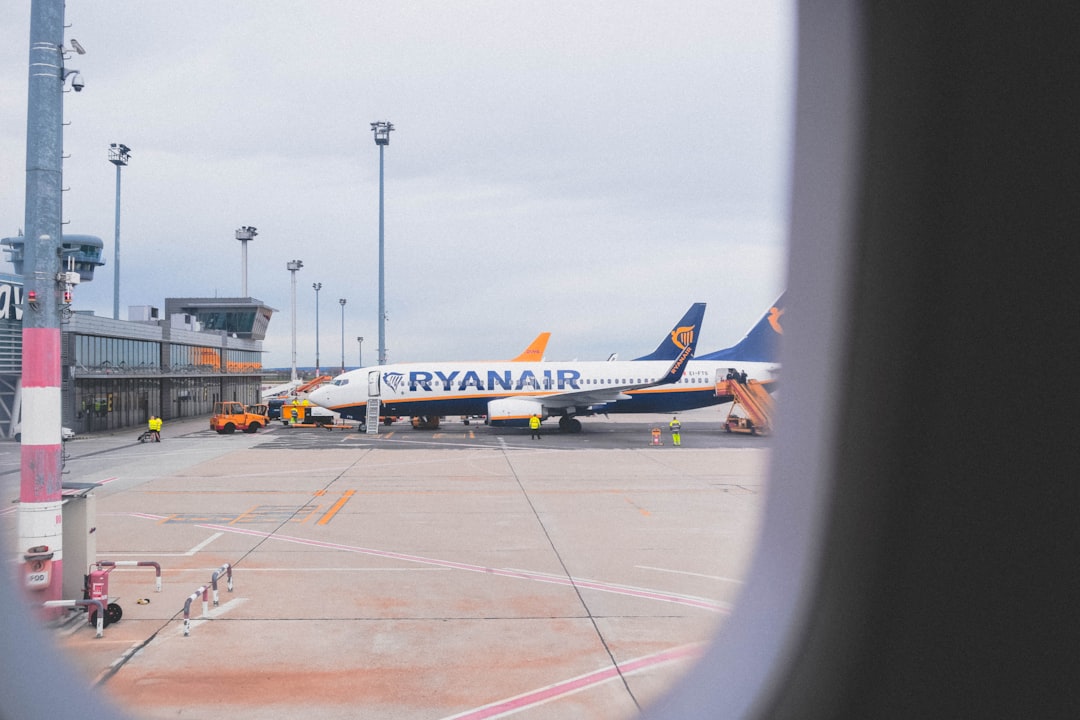
Why Ryanair Dominates European Air Travel
Ryanair is Europe’s largest airline by passenger numbers, carrying 184 million travelers in 2024 with a fleet of 611 aircraft serving 235 destinations across 37 countries. Founded in 1984, this Irish ultra-low-cost carrier revolutionized European aviation by making air travel accessible to millions through its no-frills approach and rock-bottom fares.
Key Ryanair Facts:
- Revenue: €13.44 billion (2024)
- Fleet: 611 Boeing 737 aircraft
- Destinations: 235 across 37 countries
- Load Factor: 94% (industry-leading efficiency)
- Business Model: Ultra-low-cost with ancillary revenue streams
- Primary Hubs: Dublin (DUB) and London Stansted (STN)
The airline’s success stems from its radical simplification of air travel. By using secondary airports, maintaining lightning-fast 30-minute turnarounds, and operating a single aircraft type (Boeing 737), Ryanair keeps costs impossibly low. Their online-first approach means you must check in digitally – there’s no traditional airport counter service.
But here’s what makes Ryanair fascinating for travelers: while their base fares can be shockingly cheap, their revenue model depends heavily on add-ons. Everything from seat selection to carry-on bags costs extra. Understanding this system is crucial for booking successfully.
Despite a customer service rating of just 3.0 out of 5 stars, Ryanair’s combination of extensive European coverage and unbeatable prices makes it an essential option for budget-conscious travelers exploring the continent.
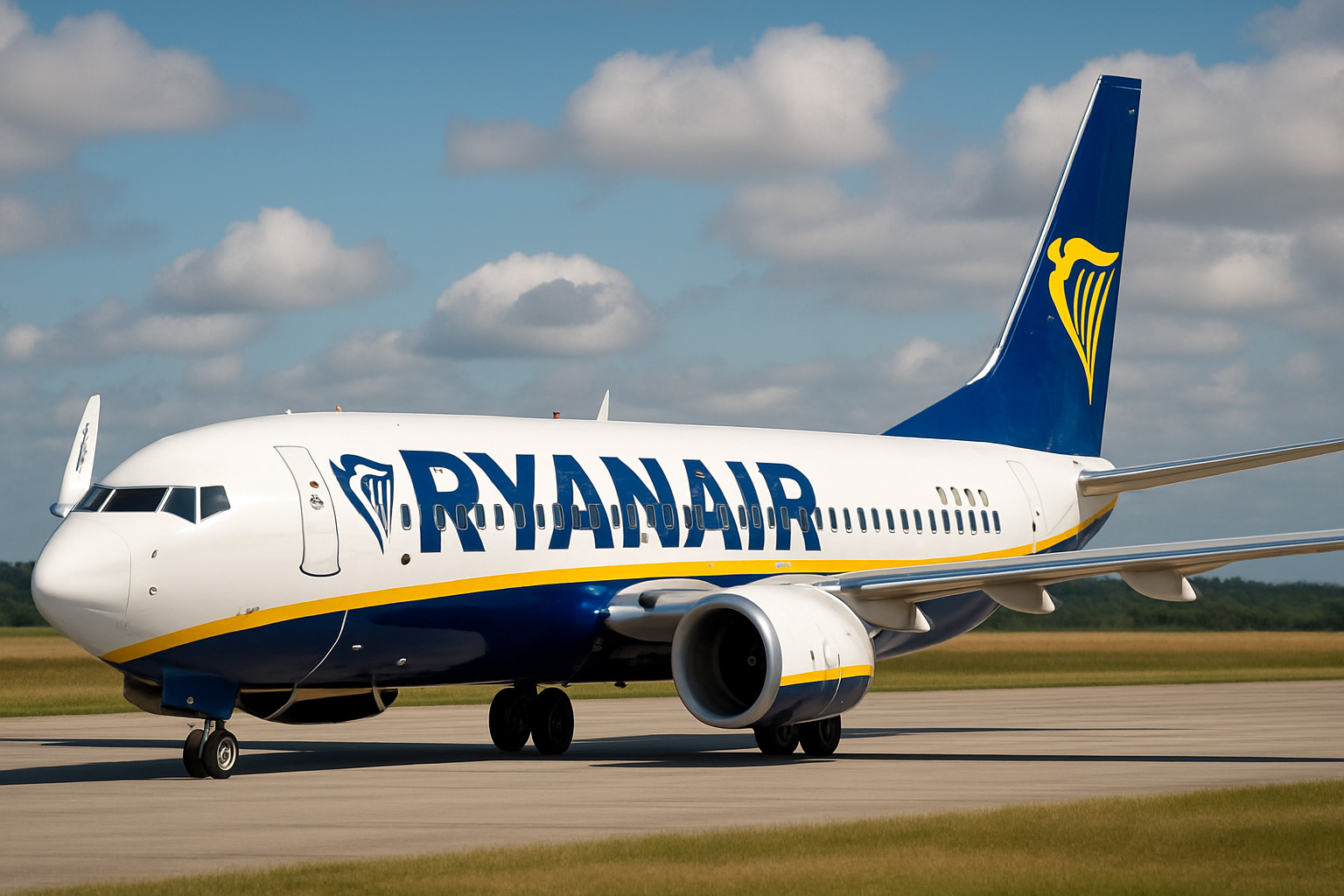
Quick ryanair definitions:
Why Choose Ryanair for Your Next Trip
When you’re planning your next European trip, Ryanair deserves serious consideration – and not just because of their famously low fares. This Irish airline has fundamentally changed how we travel across Europe, and their track record speaks for itself.
Under CEO Michael O’Leary’s bold leadership, Ryanair has transformed from a small regional carrier into Europe’s aviation powerhouse. In fiscal year 2024 alone, they carried an astounding 184 million passengers while posting a healthy net income of €1.917 billion. That’s not just impressive – it’s proof that their ultra-low-cost strategy actually works for both travelers and shareholders.
If you’re curious about their financial performance, you can check their RYA Euronext Dublin share price to see how investors view this aviation success story. The numbers consistently reflect what many budget-conscious travelers already know: Ryanair has cracked the code on affordable European travel.
What really sets them apart is their operational efficiency. That remarkable 94% load factor isn’t just a statistic – it means they’ve mastered the art of filling nearly every seat on every flight while keeping costs incredibly low. This efficiency translates directly into savings for you.
Ryanair Fleet and Network
Here’s where Ryanair’s genius really shines: they keep things beautifully simple. Their entire 611-aircraft fleet consists of Boeing 737s, including both the reliable 737-800s and the newer, more fuel-efficient 737 MAX 200s.
Why does this matter to you? When an airline operates just one aircraft type, everything becomes more streamlined. Pilots need training on only one plane, mechanics know every system inside and out, and spare parts are always available. All these efficiencies mean lower costs – and lower fares for your trips.
Ryanair operates through a smart group structure that includes Buzz, Malta Air, Lauda, and Ryanair UK. This setup helps them steer Europe’s complex aviation regulations while maintaining their no-nonsense, low-cost approach across different markets.
Their network spans an impressive 235 destinations across 37 countries. But here’s their clever trick: they often use secondary airports that major carriers avoid. Instead of expensive Frankfurt Main, you might fly into Frankfurt-Hahn. Rather than pricey Charles de Gaulle, you could land at Beauvais. These airports charge lower fees and allow faster turnarounds, keeping your ticket prices down.
Ryanair Value Proposition
The Ryanair approach is refreshingly straightforward: you pay only for what you actually need. Their unbundled pricing means that rock-bottom advertised fare covers your seat and basic transportation – nothing more, nothing less.
Want to bring a cabin bag? There’s a fee for that. Prefer choosing your specific seat? That costs extra too. Need priority boarding to guarantee overhead bin space? You can add it on. This might seem like they’re charging for everything, but there’s actually a fair logic behind it.
If you’re the type of traveler who packs light and doesn’t mind sitting wherever they assign you, you can fly across Europe for less than you’d spend on a nice dinner out. But if you want all the extras, you can add them – you’re just not paying for services other passengers use that you don’t need.
Their famous quick turnarounds – often just 30 minutes between flights – maximize how much time their planes spend in the air rather than sitting expensive on the ground. More flying time means lower costs per passenger, which translates into those surprisingly low fares that make European travel accessible to everyone.
Step-by-Step Guide to Booking Ryanair Flights Online
Booking a Ryanair flight online is surprisingly straightforward once you understand their system. We’ve broken it down into simple steps that will have you booked and ready to fly in under 10 minutes.
The key to success with Ryanair is understanding their philosophy before you start. They’ve designed their booking process to be efficient and transparent about costs. Every add-on is clearly priced, so there are no nasty surprises at checkout.
Start by visiting Ryanair.com or downloading their mobile app. The interface is clean and functional – they’ve invested heavily in making the booking experience smooth since launching online booking in the early 2000s.
Creating Your Account & Setting Alerts
While you can book as a guest, creating a myRyanair account open ups several useful features. You’ll get access to their fare finder tool, which can alert you to price drops on routes you’re interested in. The route map tool is particularly handy for finding new destinations within your budget.
Price drop alerts are genuinely useful. European flight prices can fluctuate significantly, and getting notified when your preferred route drops in price can save you substantial money. We recommend setting up alerts for flexible travel dates to maximize your savings potential.
The account also stores your passenger details, making future bookings faster. Given Ryanair’s popularity for short European hops, this time-saving feature becomes valuable quickly.
Completing the Booking in Under 5 Minutes
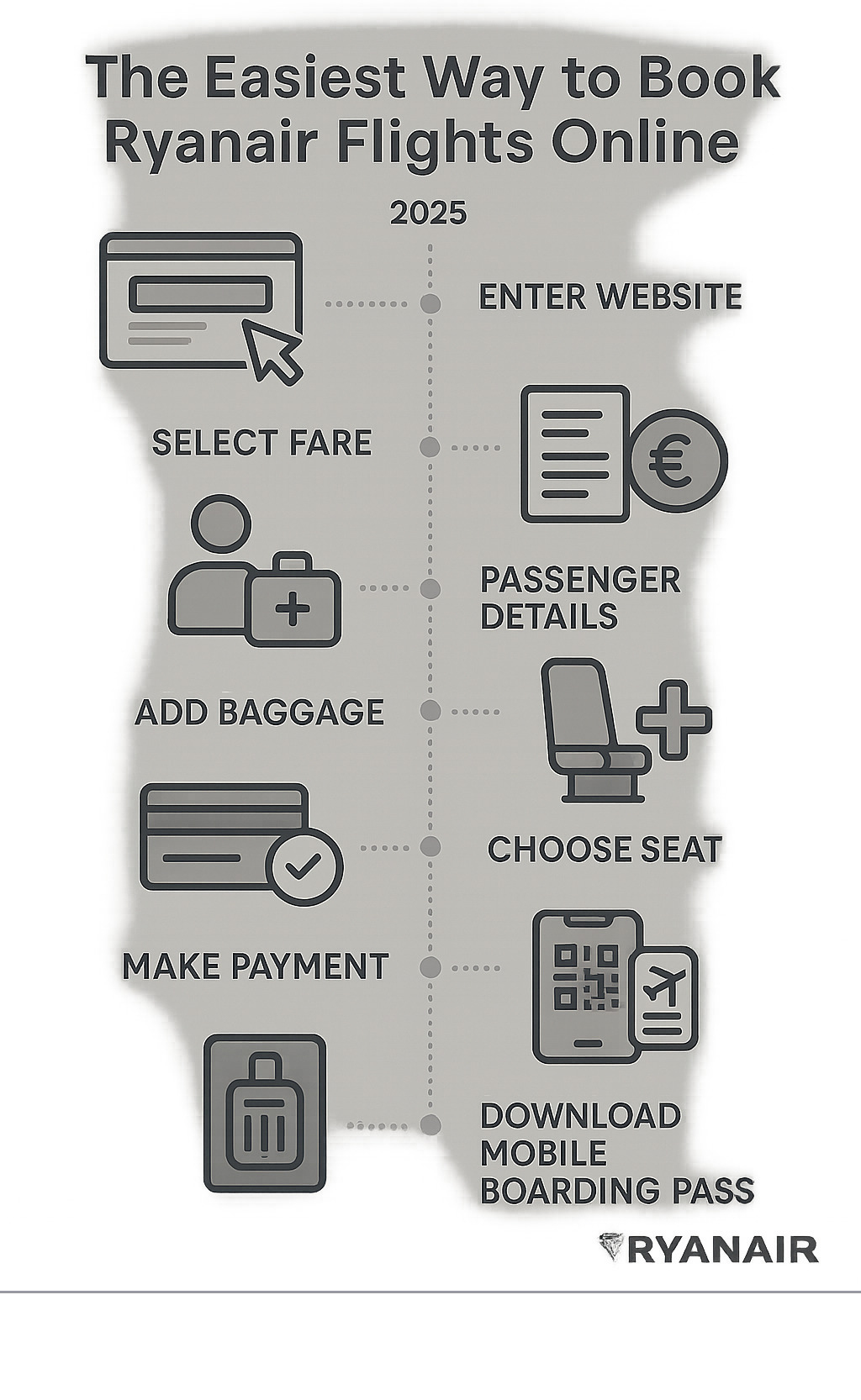
Once you’ve selected your flights, the booking process moves quickly:
-
Enter passenger details: Full names must match your ID exactly. Ryanair is strict about this, so double-check spelling.
-
Select add-ons: This is where you’ll see options for Priority & 2 Cabin Bags (€12-35 depending on route), seat selection (€4-22), and checked baggage (€12-70).
-
Review your booking: Take a moment to verify everything, especially travel dates and passenger names.
-
Complete payment: Ryanair accepts most major credit and debit cards. Avoid using credit cards that charge foreign transaction fees for international bookings.
-
Download your boarding pass: Available 30 days before departure, you can check in online from 48 hours to 2 hours before your flight.
The entire process typically takes 3-7 minutes once you know what you want. Ryanair’s system is designed for speed and efficiency.
Money-Saving Hacks & Avoiding Extra Fees
Let’s be honest – Ryanair’s fee structure can feel like a minefield if you’re not prepared. But here’s the thing: once you understand their system, it’s actually quite fair. You pay for exactly what you use, nothing more.
The secret to flying Ryanair cheaply isn’t avoiding their fees entirely (though some are easily dodged). It’s about making smart choices upfront and never getting caught off guard.
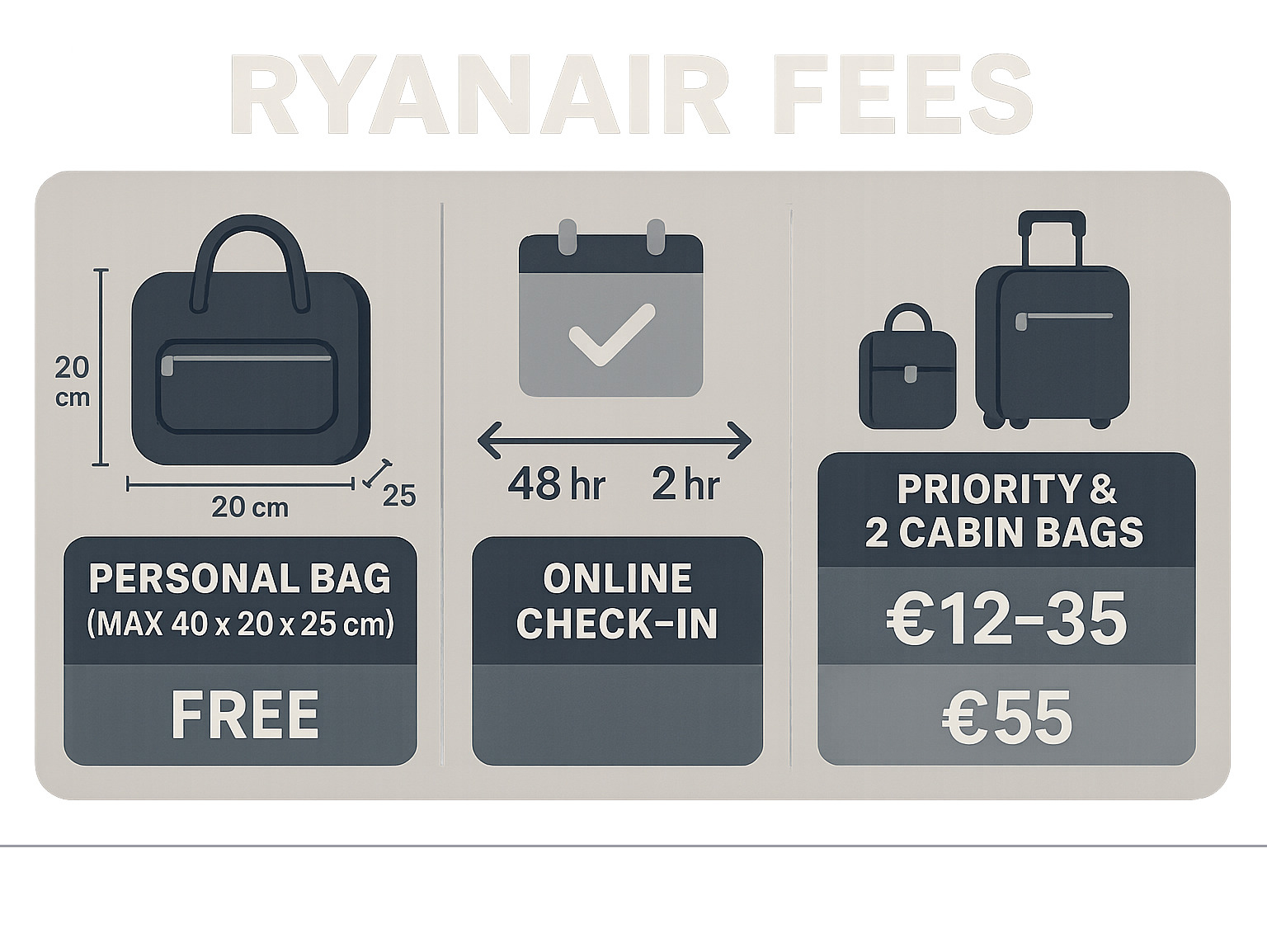
The golden rule: Ryanair’s advertised fares cover your seat and a small personal bag that fits under the seat in front of you. Everything else – from choosing your seat to bringing a proper carry-on – costs extra. But these extras are clearly priced, so you can budget accordingly.
Here’s where most travelers go wrong: they book that €15 flight to Barcelona, then get hit with unexpected charges at the airport. A €70 gate fee for an oversized bag can turn your bargain flight into an expensive lesson.
Master the personal bag dimensions: 40x20x25cm is non-negotiable. Ryanair’s bag sizers at the gate are ruthlessly accurate. We’ve watched travelers frantically trying to squeeze bags that are just 2cm too wide, only to pay hefty gate fees. Invest in a properly sized travel bag – it literally pays for itself on your first trip.
Timing is everything with check-in. Online check-in opens 48 hours before departure and closes 2 hours before your flight. Miss this window, and you’ll pay €55 at the airport – one of the easiest fees to avoid with a simple phone reminder.
Smart booking strategies can save you serious money. Tuesday and Wednesday flights typically cost 15-20% less than weekend departures. School holidays can triple prices, so flexibility with dates is your friend. That Tuesday morning flight might require a day off work, but the savings often justify it.
Payment method matters more than you’d think. Some credit cards add foreign transaction fees for international bookings, while debit cards usually process without extra charges. It’s a small detail that adds up over multiple bookings.
Secondary airports aren’t the inconvenience they once were. Many are now well-connected to city centers, and the money you save on airfare often covers ground transport costs with cash to spare.
Comparing Optional Add-Ons
The real art of Ryanair booking lies in choosing the right add-ons for your specific trip. Their unbundled approach means you can customize your experience based on what actually matters to you.
Priority & 2 Cabin Bags transforms your Ryanair experience for €12-35. You get a personal bag plus a 10kg cabin bag, priority boarding, and guaranteed overhead locker space. For weekend city breaks or business trips, this upgrade often makes perfect sense. You board first, store your bag easily, and avoid the scramble for overhead space.
But if you’re genuinely traveling light – think digital nomad with just a laptop and change of clothes – the basic fare works beautifully. No need to pay for services you won’t use.
Seat selection follows similar logic. Random assignment works fine for solo travelers who aren’t particular about location. But families traveling together should budget for seat selection (€4-14 per person) to avoid being scattered across the plane. Trust us, the peace of mind is worth the cost when traveling with children.
Extra legroom seats (€14-22) become worthwhile on flights over two hours, especially for taller passengers. Front seats (€8-22) offer faster disstartation but the same legroom as standard seats – useful if you have tight connections.
Checked baggage decisions should be based on trip length and packing style. The 10kg option (€12-35) suits short trips perfectly, while the 20kg allowance (€20-70) offers better value for longer stays. Here’s a clever trick: Ryanair allows bag pooling across passengers on the same booking, so couples can share one 20kg bag instead of buying two 10kg allowances.
The key is honest self-assessment. Are you someone who packs three outfit options for every day, or do you travel with a capsule wardrobe? Do you need to bring back souvenirs, or are you happy with photos and memories? Answer these questions before booking, not at the airport.
Policies, Customer Experience & COVID-19 Lessons
Let’s be refreshingly honest about Ryanair’s customer service approach – it’s functional rather than fancy. With a customer service score of 3.0 out of 5 stars, they’re not exactly winning hearts, but they’re not trying to either. Their philosophy is straightforward: we get you from A to B safely and cheaply, without the frills.
This no-nonsense approach means you’ll encounter efficient operations but minimal hand-holding. When you do need help, their customer service team can be surprisingly helpful, though don’t expect the warm, personal touch you might find elsewhere. It’s business-focused service that matches their business model.
EU261 compensation is one area where Ryanair has genuinely improved. When flights are cancelled or significantly delayed due to airline issues, you’re entitled to €250-600 compensation plus accommodation if needed. The airline now processes these claims much more efficiently than in their early days, partly due to regulatory pressure and partly due to operational maturity.
The COVID-19 pandemic was a wake-up call for many airlines, and Ryanair was no exception. Initially resistant to offering refunds beyond strict legal requirements, they eventually adapted their policies as the crisis unfolded. Their FY 2024 Annual Report reveals how they weathered the storm while maintaining financial stability – a testament to their robust business model.
One positive outcome from the pandemic was streamlined carry-on rules. Gone are the confusing distinctions between different cabin bag sizes. Now it’s beautifully simple: personal bag travels free, Priority & 2 Cabin Bags costs €12-35, or checked bags start from €12-70. This clarity makes planning much easier for travelers.
The airline’s relationship with union relations has been historically rocky, though recent years have seen more collaborative approaches. Their direct communication style, while sometimes blunt, has become more professional as the company matured.
Ryanair’s Approach to Safety & Innovation
Despite their budget reputation, Ryanair takes safety seriously – and their record proves it. Their Boeing 737 fleet features modern fuel-efficient winglets, and pilots undergo rigorous training programs. The airline boasts an excellent safety record with no fatal accidents in their modern operational era.
Innovation at Ryanair focuses on operational efficiency rather than passenger luxury. They were pioneers in online check-in for European budget carriers, launching the service in 2006 and essentially forcing the entire industry to follow suit. Their mobile app now handles everything from initial booking to digital boarding passes, dramatically reducing airport processing costs.
Recent innovations include contactless boarding processes and digital-first customer service channels. While some passengers miss traditional human interaction, these technological advances directly contribute to keeping fares low – which is exactly what most Ryanair passengers prioritize.
The airline has also reformed problematic practices like excessive credit-card charges following regulatory pressure. This shows their willingness to adapt when policies clearly disadvantage customers.
One controversial misstep was their brief Afrikaans test controversy for South African passport holders, which they eventually abandoned following widespread criticism. This incident highlights how Ryanair sometimes pushes boundaries in ways that generate negative publicity, though they do adjust course when needed.
Future Growth & Sustainability Roadmap
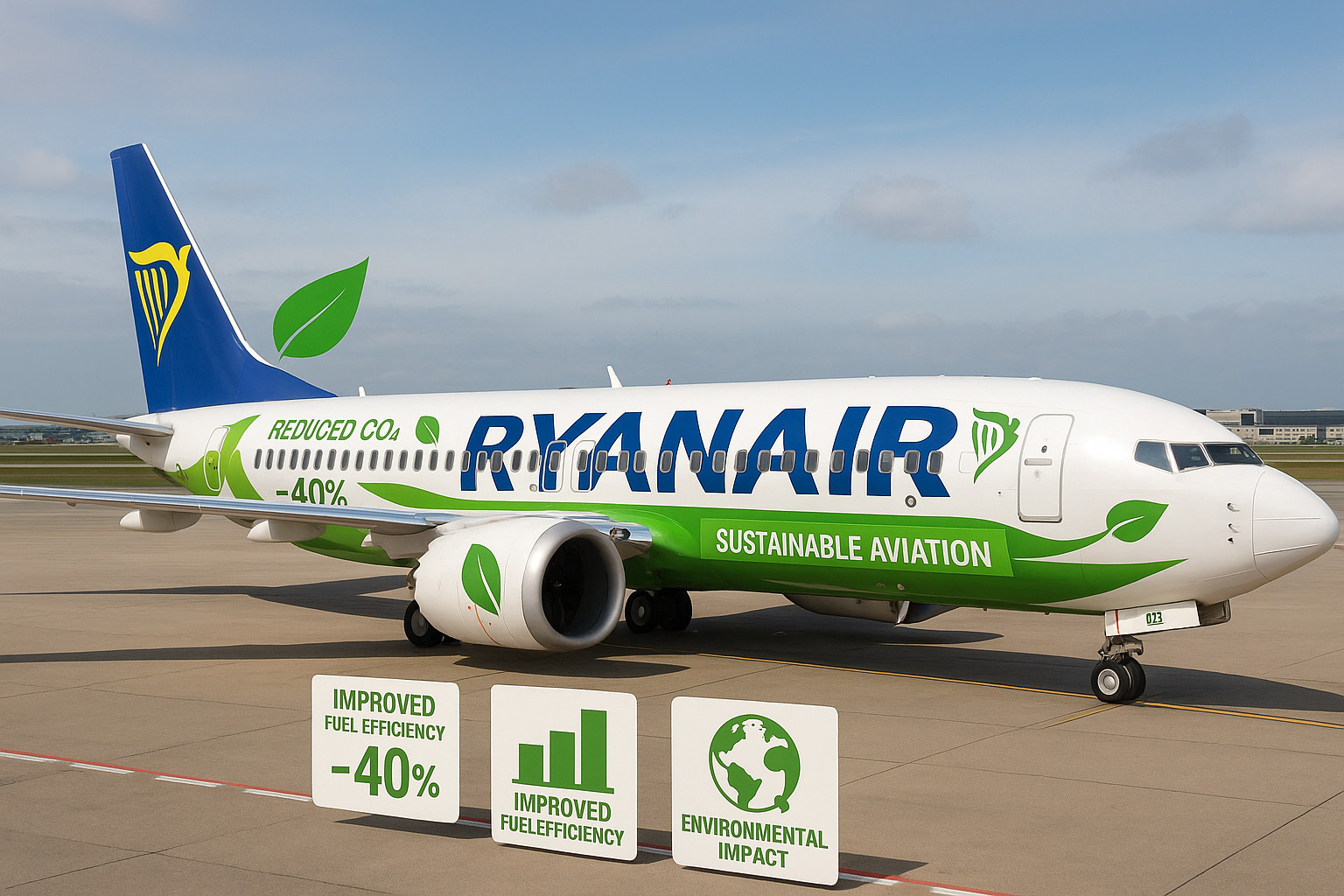
Ryanair’s ambitious expansion plans paint a picture of an airline that’s far from finished growing. Their massive order for 300 Boeing 737 MAX 10 aircraft isn’t just about replacing older planes – it’s a bold statement about the future of European aviation. These shiny new aircraft are 20% more fuel-efficient than their predecessors, which means lower costs for Ryanair and potentially lower fares for us travelers.
But here’s where things get really interesting: Ryanair is stretching beyond Europe in a big way. Their €1.4 billion investment in Morocco shows they’re serious about replicating their European success elsewhere. With over 1,100 weekly flights planned across 175 routes (including 35 brand-new ones), they’re targeting 5 million annual passengers in Morocco alone. That’s not just expansion – that’s creating an entirely new market.
The environmental conversation around Ryanair is complicated, and honestly, it deserves a nuanced look. Environmental groups often criticize the airline for making flying so affordable that it encourages more trips. But Ryanair’s counter-argument has merit: their 94% load factor means planes are actually full, unlike some traditional carriers flying half-empty aircraft across the same routes.
Their commitment to net-zero emissions by 2050 might sound distant, but the practical steps are already happening. Those new MAX 10 aircraft aren’t just more comfortable – they’re significantly cleaner. The airline argues that efficient flying is better than inefficient flying, and it’s hard to argue with a 94% load factor as evidence of responsible capacity management.
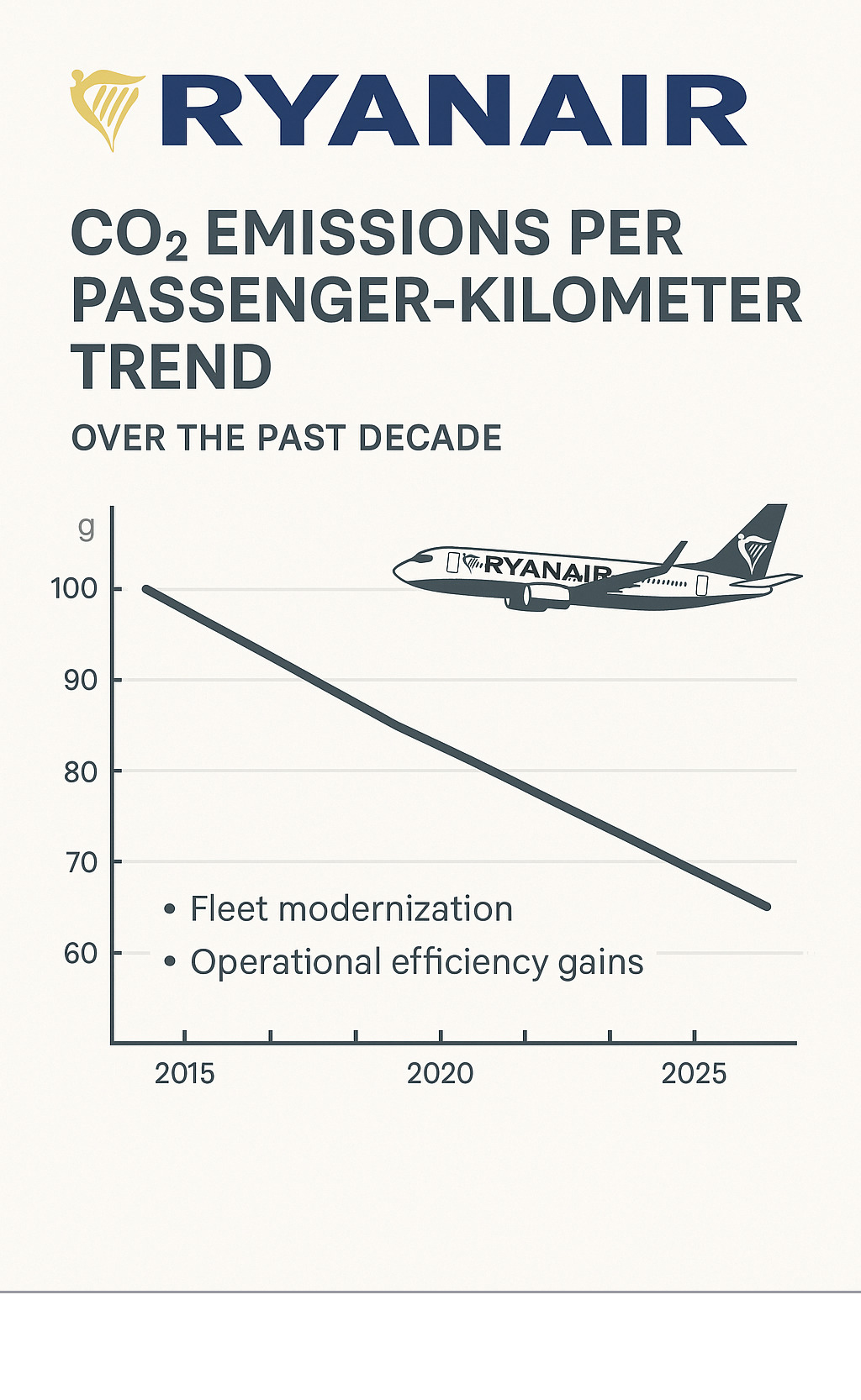
Critics raise valid concerns about Ryanair enabling increased flying through rock-bottom prices. It’s a fair point – when flights cost less than a tank of gas, people definitely fly more often. The airline’s response focuses on efficiency: they’d rather see one full plane than two half-empty ones covering the same route.
How Ryanair Plans to Stay #1 in Europe
Staying on top in the competitive European aviation market requires constant innovation and strategic thinking. Ryanair’s approach centers on three core strategies that have served them well: network expansion into underserved markets, digital innovation that goes beyond just selling flights, and relentless cost leadership that keeps competitors scrambling.
Their recent route launches tell an interesting story. New connections like Prague to Paphos and routes from Kosice demonstrate their knack for connecting secondary cities with leisure destinations. Instead of fighting for slots at congested major airports, they’re creating entirely new travel patterns. It’s clever – they’re not just competing for existing passengers, they’re creating new ones.
The digital change at Ryanair extends far beyond their booking engine. Their mobile app has evolved into a travel platform that promotes hotels, car rentals, and travel insurance alongside flights. While flight margins remain razor-thin, these ancillary services offer much higher profitability. It’s a smart evolution from pure airline to travel facilitator.
Perhaps most fascinatingly, Ryanair uses their scale as a negotiating tool with governments. Their recent threat to cut 1.5 million seats from German routes unless aviation taxes were reduced shows how they leverage their size to influence policy. When you’re moving 184 million passengers annually, governments listen.
The airline’s future success hinges on maintaining this delicate balance between aggressive growth and operational efficiency. Their track record suggests they’ll keep finding creative ways to make European travel more accessible while staying profitable. For budget-conscious travelers, that’s excellent news.
Frequently Asked Questions about Booking Ryanair Flights Online
Booking with Ryanair online can feel overwhelming at first, especially if you’re new to budget airlines. We get asked the same questions repeatedly, so let’s clear up the most common concerns to make your booking experience smoother.
These aren’t just bureaucratic details – getting these basics wrong can cost you serious money or even prevent you from traveling. We’ve seen passengers turned away at gates for simple mistakes that could have been avoided.
What ID do I need to check in for a Ryanair flight?
The ID requirements depend on where you’re flying, but Ryanair is stricter than many airlines about name matching. For flights within the European Union, you can use either a valid passport or national ID card. International flights always require a passport.
Here’s the crucial part: the name on your booking must match your ID exactly. We’re talking character-for-character matching. Even small differences like “Chris” versus “Christopher” or missing middle names can cause problems at the gate.
When booking, take a moment to look at your ID and type your name exactly as it appears. It’s worth the extra 30 seconds to avoid the €160 name change fee later. If you do make a mistake, fix it immediately – Ryanair allows free corrections within 24 hours of booking for minor spelling errors.
How early can I download my Ryanair boarding pass?
Online check-in opens exactly 48 hours before your scheduled departure time and closes 2 hours before departure. This window is firm – there’s no flexibility on either end. Miss it, and you’ll pay €55 for airport check-in.
Once you check in, your boarding pass becomes available immediately in your myRyanair account and gets emailed to you. You can save it to your phone’s wallet app or print it at home. We always recommend checking in the moment that 48-hour window opens, especially during busy travel periods when the system can get overloaded.
The boarding pass includes your seat assignment (if you didn’t pre-select one) and any add-ons you purchased. Double-check everything is correct before heading to the airport – it’s much easier to fix issues online than at the gate.
Can I change my flight date after booking?
Yes, but it’s expensive enough that you’ll want to avoid it if possible. Ryanair charges between €45-160 per person per flight for changes, plus you’ll pay any difference in fare. Changes must be made at least 2.5 hours before your original departure time.
Here’s the reality: for many routes, especially during busy periods, it’s often cheaper to book a completely new flight than to pay the change fees. Ryanair tickets are non-refundable except in specific circumstances like airline cancellations or qualifying EU261 situations.
If you need flexibility, consider their Flexi Plus fare at booking time. It costs more upfront but includes free flight changes and other benefits that can save money if your plans change. For most travelers though, the basic fare works fine if you’re confident about your travel dates.
The key with Ryanair is understanding their system before you book. They’re transparent about costs and policies – there are no hidden surprises if you read the terms. Once you understand how they operate, booking becomes straightforward and stress-free.
Conclusion
Mastering Ryanair’s online booking system opens up a world of affordable European travel. The secret isn’t fighting their no-frills approach – it’s understanding how to work with it. Once you grasp their straightforward philosophy of paying only for what you use, booking becomes surprisingly simple.
We’ve found that Ryanair shines brightest for specific travel styles. Weekend city breaks where you’re packing light? Perfect. Multi-city European trips where you need flexible one-way tickets? Ideal. Solo travelers who don’t mind random seat assignments? You’ll save a fortune.
The environmental angle is worth considering too. When you choose Ryanair’s packed flights over half-empty alternatives, you’re actually making a more sustainable choice. Their 94% load factor means you’re sharing the environmental impact with more passengers, reducing your individual carbon footprint per mile traveled.
Here’s what we’ve learned works best: check in online religiously (those €55 airport fees add up quickly), measure your bags twice before leaving home, and arrive at the airport with realistic expectations. You’re buying transportation, not luxury – and there’s absolutely nothing wrong with that approach.
For budget-conscious travelers wanting to explore Europe’s hidden corners, Ryanair remains best. Their network connects smaller cities that major airlines often ignore, creating travel opportunities that simply wouldn’t exist at these prices. Yes, the service is basic, but the destinations are absolutely extraordinary.
The beauty of Ryanair lies in its honesty. They tell you exactly what you’re getting and what everything costs. No hidden surprises, no fine print gotchas – just straightforward, efficient transportation across Europe at prices that make frequent travel possible.
Ready to explore Europe sustainably and affordably? More info about sustainable flying can help you make responsible travel choices while still taking advantage of Ryanair’s incredible European network.